


2026 Provide Updated NAHQ CPHQ Dumps as Practice Test and PDF
CPHQ Dumps are Available for Instant Access
The CPHQ examination is a computer-based exam that consists of 140 multiple-choice questions. Candidates have three hours to complete the exam. CPHQ exam is offered at testing centers throughout the United States and internationally. Candidates must meet certain eligibility requirements before they can take the exam, including having a minimum of two years of experience in healthcare quality and patient safety.
NEW QUESTION # 346
One of the first steps in preparing for an organizational accreditation survey Is to have a quality professional
- A. conduct a gap analysis of the identified standards against current practices.
- B. Identify the root causes of the most recent adverse events that have occurred.
- C. complete a competency examination on the process of writing action plans.
- D. submit an electronic application to the organization Identifying a date for survey.
Answer: A
Explanation:
One of the first steps in preparing for an organizational accreditation survey is to conduct a gap analysis of the identified standards against current practices123. This involves understanding the accreditation standards and reviewing adherence to these standards before applying for accreditation1. A gap analysis helps identify areas of weakness or nonconformance to the standards2. This process is crucial in setting up the organization for success in the accreditation survey1.
References:
https://www.carf.org/accreditation/survey-preparation-accreditation/
https://accreditation.org/accreditation-processes
NEW QUESTION # 347
Based on the chart below, which of the following should be addressed first?
- A. pain and constipation
- B. pain, constipation, PCP unavailable, nausea, and vomiting
- C. pain, constipation, PCP unavailable, and nausea
- D. pain, constipation, and PCP unavailable
Answer: D
Explanation:
Based on the provided Pareto chart of general surgery readmission causes, the most significant causes should be addressed first to have the greatest impact on reducing readmissions.
* Pareto Principle (80/20 Rule): The chart illustrates that a small number of causes contribute to the majority of the readmissions. The top three causes-pain, constipation, and PCP (Primary Care Provider) unavailable-account for the most significant portion of the readmissions.
* Prioritization of Interventions: By addressing these top three causes first, the healthcare team can potentially prevent the majority of readmissions, making the intervention more efficient and effective.
* Strategic Focus: Focusing on pain, constipation, and the unavailability of PCPs aligns with the principle of focusing on the "vital few" causes rather than spreading resources thinly across many less significant issues.
References: (Based on Healthcare Quality NAHQ documents and resources)
* NAHQ Quality Improvement and Data Analysis Modules.
* CPHQ Study Guide, Section on Pareto Analysis in Quality Improvement.
=========
NEW QUESTION # 348
An organization's 30-day readmission rate for heart failure patients is at the upper limit of the acceptable CMS range. What is the most appropriate step for evaluating this rate?
- A. Encourage nursing staff to improve communication with patients and families
- B. Have case management review all readmissions and report patterns to medical staff
- C. Monitor the rate for six months and begin analysis only if it exceeds the limit
- D. Convene an interdisciplinary group to review current activities to ensure sustainability
Answer: D
Explanation:
According to the NAHQ CPHQ exam blueprint, when performance is within acceptable limits but at risk, the priority is sustainment and prevention of regression, not delayed action or reactive case review.
Option C is correct because convening an interdisciplinary group allows the organization to evaluate existing interventions, ensure consistent implementation, and strengthen processes that protect against CMS payment penalties. This proactive approach aligns with continuous readiness and population health management principles.
Option B delays action until performance worsens. Option A proposes a single intervention without assessment. Option D is reactive and resource-intensive without first confirming a trend.
The CPHQ framework stresses early, proactive evaluation when metrics approach thresholds, making Option C the most appropriate step.
NEW QUESTION # 349
Which of the following tools is most appropriate to analyze a medication administration process?
- A. Fishbone diagram
- B. Flow chart
- C. Bar graph
- D. Pareto chart
Answer: B
Explanation:
Detailed Explanation:
Analyzing a medication administration process requires understanding the sequence and steps involved. Here' s an evaluation of each option:
Option A: Flow Chart
A flow chart maps out a process step-by-step, making it ideal for analyzing and identifying potential bottlenecks or errors in the medication administration workflow.
Option B: Pareto Chart
A Pareto chart prioritizes issues based on frequency but does not provide a sequential view of the process.
Option C: Bar Graph
A bar graph displays data quantities but does not illustrate the steps or sequence of a process.
Option D: Fishbone Diagram
A fishbone (Ishikawa) diagram helps identify potential causes but is less suited for analyzing the sequence of the administration process itself.
References:
Flow charts are recommended by quality improvement methodologies for analyzing detailed process steps, as outlined in process improvement and CPHQ study resources.
NEW QUESTION # 350
Within any unit, organization, or system, there will be barriers to spread and adoption (e.g., organizational culture, communication, leadership support).
However, failure to transfer knowledge effectively may result in (Choose two):
- A. Benchmarks
- B. Inconsistency
- C. Unnecessary waste
- D. organizational persistence
Answer: B,C
NEW QUESTION # 351
Each provider in a primary care practice has the potential of earning a $20,000 bonus based on individual performance on select Healthcare Effectiveness Data and Information Set (HEDIS) indicators as outlined below: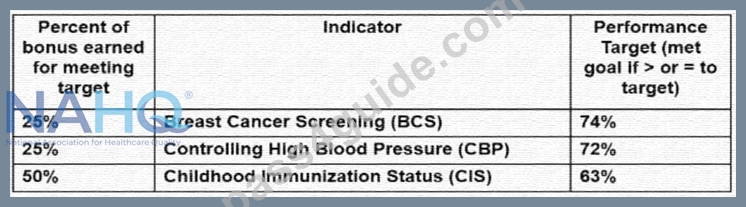
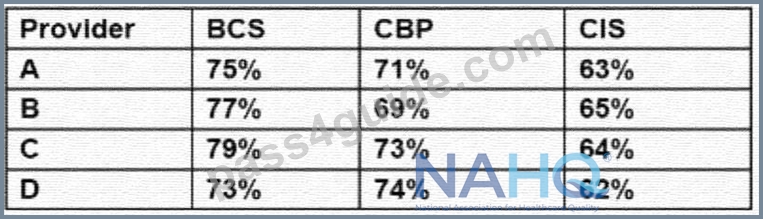
Based on this information, which of the following conclusions is accurate?
- A. Provider B earned the lowest bonus.
- B. Provider D earned a $15,000 bonus.
- C. Provider C earned the highest bonus.
- D. Provider A earned a $10,000 bonus.
Answer: C
Explanation:
To calculate the bonus, evaluate whether each provider met the performance targets for each HEDIS indicator and multiply by the corresponding percentage of the $20,000 bonus.
* Provider A:
* BCS: 75% # 74% # 25% of $20,000 = $5,000
* CBP: 71% < 72% # $0
* CIS: 63% # 63% # 50% of $20,000 = $10,000
* Total = $15,000
* Provider B:
* BCS: 77% # 74% # $5,000
* CBP: 69% < 72% # $0
* CIS: 65% # 63% # $10,000
* Total = $15,000
* Provider C:
* BCS: 79% # 74% # $5,000
* CBP: 73% # 72% # $5,000
* CIS: 64% # 63% # $10,000
* Total = $20,000
* Provider D:
* BCS: 73% < 74% # $0
* CBP: 74% # 72% # $5,000
* CIS: 62% < 63% # $0
* Total = $5,000
Provider C earned the highest bonus at $20,000, meeting or exceeding all three performance targets. Provider D earned the lowest bonus, $5,000, meeting only the CBP target.
References:
National Committee for Quality Assurance (NCQA), HEDIS Technical Specifications, 2024 The Joint Commission, Performance Improvement Standards, 2024
NEW QUESTION # 352
Based on the data below, which unit should the quality Improvement coordinator focus on?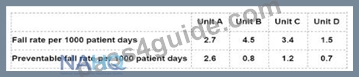
- A. Unit A
- B. Unit D
- C. Unit B
- D. Unit C
Answer: C
Explanation:
* Based on the data below, which shows the percentage of patients who acquired a hospital-associated infection (HAI) in each unit, the quality improvement coordinator should focus on Unit C, which has the highest rate of HAI among the four units.
* A hospital-associated infection (HAI) is an infection that patients get during or after receiving health care in a hospital or other health care facility. HAIs can cause serious complications, increase morbidity and mortality, prolong hospital stays, and increase health care costs. Therefore, preventing and reducing HAIs is a key quality and safety goal for health care organizations.
* A quality improvement coordinator is a professional who develops and implements quality improvement initiatives, monitors and evaluates quality performance, and provides education and support to staff and leaders on quality methods and tools. One of their responsibilities is to identify and prioritize areas for improvement based on data analysis and evidence-based practices.
* To determine which unit should be the focus of quality improvement efforts, the quality improvement coordinator can use a data analysis tool such as a Pareto chart, which shows the frequency or impact of different factors or causes in descending order, along with a cumulative line that indicates the percentage of the total. A Pareto chart can help identify the most significant issues or opportunities for improvement, based on the 80/20 rule, which states that 80% of the effects come from 20% of the causes.
* Using the data below, a Pareto chart can be created as follows:
Table
Unit
HAI Rate (%)
A
5
B
7
C
12
D
4
* The Pareto chart shows that Unit C has the highest HAI rate (12%), followed by Unit B (7%), Unit A (5%), and Unit D (4%). The cumulative line shows that Unit C alone accounts for 40% of the total HAI rate, and Units C and B together account for 63.3% of the total HAI rate. Therefore, according to the Pareto principle, the quality improvement coordinator should focus on Unit C, as it represents the most significant problem area and the greatest opportunity for improvement.
* The quality improvement coordinator can then conduct a root cause analysis to identify the possible factors or causes that contribute to the high HAI rate in Unit C, such as staff compliance, infection control practices, patient characteristics, environmental factors, etc. A root cause analysis can be facilitated by using a visual tool such as a fishbone diagram, which organizes possible factors into categories, such as people, process, equipment, environment, etc. The quality improvement coordinator can also collect and compare data from other units or sources to identify gaps and best practices.
* Based on the root cause analysis, the quality improvement coordinator can then develop and implement an action plan to address the identified causes and improve the HAI rate in Unit C. The action plan should include specific, measurable, achievable, relevant, and time-bound (SMART) goals, interventions, and indicators. The quality improvement coordinator can also involve the staff and leaders of Unit C in the planning and implementation process, to ensure their engagement and ownership of the improvement efforts.
* The quality improvement coordinator should also monitor and evaluate the progress and outcomes of the action plan, using data collection and analysis tools such as run charts, control charts, or statistical process control (SPC), which can show the variation and trends in the HAI rate over time. The quality improvement coordinator should also provide feedback and recognition to the staff and leaders of Unit C, and make adjustments to the action plan as needed, based on the data and evidence.
References:
* NAHQ HQ Principles, Module 2: Data Management, Lesson 2.3: Data Analysis Tools, Topic 2.3.1:
Pareto Chart, Topic 2.3.2: Fishbone Diagram
* NAHQ Learning Lab: The Role of the Healthcare Quality Professional in Population Health Management, Module 3: Data Collection and Analysis, Slide 16: Pareto Chart, Slide 18: Fishbone Diagram
* NAHQ Journal for Healthcare Quality, Volume 42, Issue 5, September/October 2020, Article:
Utilization of Improvement Methodologies by Healthcare Quality Professionals During the COVID-19 Pandemic, Page 283: Figure 1. Pareto Chart of COVID-19 Cases by State as of June 30, 2020
* NAHQ News and Media, News: Shaping the Future of the Healthcare Quality Profession, Paragraph 5:
The Role of the Quality Improvement Coordinator
* NAHQ Resources, Healthcare Quality Solutions: Ready Your Workforce for Quality, Page 5: The Role of the Quality Improvement Coordinator
NEW QUESTION # 353
Which of the following is an example of a social determinant of health used to monitor a quality improvement initiative?
- A. age
- B. neighborhood
- C. diabetes status
- D. race
Answer: B
Explanation:
A social determinant of health refers to the conditions in which people are born, grow, live, work, and age, which can influence health outcomes. "Neighborhood" is an example of a social determinant of health, as it encompasses various factors like access to healthcare, safety, environmental conditions, and availability of healthy foods, which can all affect health outcomes and are often monitored in quality improvement initiatives.
Diabetes status (A): This is a health condition, not a social determinant.
Race (B): While race can impact health disparities, it is considered a demographic factor rather than a direct social determinant of health.
Age (C): This is a demographic factor that affects healthcare needs, but it is not categorized as a social determinant of health.
Reference
NAHQ Body of Knowledge: Social Determinants of Health in Quality Improvement NAHQ CPHQ Exam Preparation Materials: Monitoring Social Determinants in Healthcare Initiatives
NEW QUESTION # 354
An organization Is Implementing a new electronic medical record and has employed a project manager.
At the first meeting, the project manager observes the following:
* The team estimates It Is one-fourth finished with Identifying benchmark organizations.
* Team members have not yet begun to identify the current state.
- They are halfway through collecting public data, which puts them slightly behind schedule for that task.
Which of the following tools should the quality Improvement project manager recommend?
- A. Ishlkawa diagram
- B. Design of Experiments
- C. Model for Improvement
- D. Gantt chart
Answer: D
Explanation:
A Gantt chart is a type of bar chart that illustrates a project schedule1. This tool is used in project management, and it's particularly useful in the scenario described because it can help the team visualize their progress on different tasks1.
In this case, the team is at different stages with various tasks: they're one-fourth finished with identifying benchmark organizations, they haven't started identifying the current state, and they're halfway through collecting public data1. A Gantt chart can help them see all these tasks and their progress in one place, making it easier to manage their work and stay on schedule1.
While the other tools mentioned (Model for Improvement, Design of Experiments, Ishikawa diagram) can be useful in certain scenarios, they don't specifically address the need to visualize and manage progress on multiple tasks23. Therefore, the Gantt chart is the most appropriate tool to recommend in this situation1.
NEW QUESTION # 355
An organization has identified an increase in safety events related to the treatment of patients who are unable to give consent. At the beginning of the improvement process, which of the following tools should the healthcare quality professional use to assist the team?
- A. PERT chart
- B. force field analysis
- C. stakeholder analysis
- D. flow chart
Answer: C
Explanation:
Stakeholder analysis (B) identifies and assesses stakeholders' interests and influence at the start of an improvement process, ensuring buy-in. Flow charts (A), PERT charts (C), and force field analysis (D) are less critical initially. NAHQ prioritizes stakeholder engagement for initiating improvement projects.
NAHQ CPHQ Study Guide, Performance and Process Improvement Section, "Stakeholder Engagement in Quality Improvement"; NAHQ CPHQ Practice Questions, Improvement Process Tools.
NEW QUESTION # 356
A healthcare system has multiple medical clinics across a large geographic area. What is the best way to deliver education to assure continuous survey readiness?
- A. mandatory modules on accreditation standards
- B. just-in-time training to the highest risk clinics
- C. train the trainer sessions with clinic managers
- D. one-on-one sessions with noncompliant employees
Answer: C
Explanation:
In a healthcare system with multiple medical clinics across a large geographic area, the best way to ensure continuous survey readiness is to conduct "train the trainer" sessions with clinic managers. This method leverages the expertise of clinic managers, who can then disseminate the training and knowledge to their respective teams. It ensures consistency across clinics, allows for local adaptation, and facilitates ongoing readiness. Clinic managers are in a good position to monitor compliance and provide just-in-time training as needed.
* Mandatory modules on accreditation standards (B): While useful, this method may not be as effective in ensuring consistent and practical application across multiple sites.
* One-on-one sessions with noncompliant employees (C): This approach is resource-intensive and reactive rather than proactive.
* Just-in-time training to the highest risk clinics (D): While this can be effective in specific situations, it does not provide a comprehensive approach to continuous readiness across all clinics.
References
* NAHQ Body of Knowledge: Training and Education in Healthcare Quality
* NAHQ CPHQ Exam Preparation Materials: Ensuring Continuous Survey Readiness
=========
NEW QUESTION # 357
The most Important determinant of quality Improvement success is
- A. the type of organization.
- B. the CQI model selected.
- C. monetary resource allocation.
- D. organizational culture.
Answer: B
NEW QUESTION # 358
Training priorities are being determined based on treatment record review results shown below:
Category
Item Weight
% Compliance
Assessment
1.5
90
External Communication
0.5
75
Care Plan
1.5
80
Progress Notes
1.0
75
Discharge Plan
1.0
80
Which area should take priority for training?
- A. External communication
- B. Progress notes
- C. Care plan
- D. Assessment
Answer: C
Explanation:
The NAHQ CPHQ exam blueprint emphasizes prioritizing improvement efforts based on weighted impact, not compliance alone. When weights differ, lower performance in high-weight categories represents greater risk.
Option B is correct because Care Plan has a high weight (1.5) and suboptimal compliance (80%), making it a higher priority than lower-weight categories with similar or worse compliance.
External communication has low compliance but minimal weight. Progress notes have moderate weight.
Assessment has high weight but strong compliance.
The CPHQ framework reinforces using weighted scoring to guide training and improvement priorities, making Care Plan the correct focus.
NEW QUESTION # 359
Measurement of variation in health care and its application to quality improvement must begin with the identification and articulation of:
- A. Understanding true variation versus artifact or statistical error
- B. The standard against which is to be compared a process based on extensive research, trial and error and collaborative discussion
- C. What is to be measured?
- D. Assignable variation
Answer: B
NEW QUESTION # 360
Which of the following is an example of an alternative payment model (APM)?
- A. Collaborative care model
- B. Patient-centered medical home
- C. Shared savings program
- D. Hospital at home program
Answer: C
Explanation:
Alternative Payment Models (APMs) are payment approaches developed by the Centers for Medicare & Medicaid Services (CMS) and other payers that provide added incentives to clinicians to deliver high-quality and cost-efficient care. APMs can apply to a specific clinical condition, a care episode, or a population.
* Option A: Patient-Centered Medical Home (PCMH)
PCMH is a care delivery model where patient treatment is coordinated through their primary care physician to ensure they receive the necessary care when and where they need it. While it focuses on care coordination and communication, it is not primarily a payment model.
* Option B: Shared Savings Program
The Shared Savings Program is an APM that encourages providers to reduce healthcare costs for a defined patient population by offering them a percentage of any net savings realized as a result of their efforts. This model aligns financial incentives with the goal of improving patient outcomes and reducing unnecessary spending.
* Option C: Hospital at Home Program
This program provides hospital-level care to patients in their homes. While it represents an innovative care delivery model, it is not primarily structured as a payment model.
* Option D: Collaborative Care Model
This model integrates mental health services into primary care settings. It focuses on care delivery and is not primarily a payment model.
Therefore, among the options provided, the Shared Savings Program (Option B) is the example of an Alternative Payment Model (APM).
References:
* Centers for Medicare & Medicaid Services (CMS) - "Alternative Payment Models"
NEW QUESTION # 361
There is an increased incidence of type 2 diabetes among patients living near a healthcare organization as compared to the state.
Considering social determinants of health, which of the following strategies can be used to address this problem?
- A. Collaborate with local farmers' markets to make fresh produce more widely available.
- B. Set up a community-based education program about blood glucose monitoring.
- C. Educate newly diagnosed patients on diabetes disease management.
- D. Review evidence-based diabetes management protocols with primary care providers.
Answer: A
Explanation:
Addressing the increased incidence of type 2 diabetes through the lens of social determinants of health involves addressing broader factors that impact health. Collaborating with local farmers' markets to make fresh produce more widely available is a strategy that addresses the social determinants of health by improving access to healthy food options. This approach can help reduce the risk of diabetes by making it easier for community members to make healthy dietary choices, thereby addressing one of the root causes of the increased diabetes incidence.
Educate newly diagnosed patients on diabetes disease management (A): While important, this strategy focuses on managing diabetes after it occurs rather than addressing the social determinants that contribute to its onset.
Set up a community-based education program about blood glucose monitoring (B): This is also important for management but does not directly address the social determinants that lead to the higher incidence.
Review evidence-based diabetes management protocols with primary care providers (C): This improves care quality but does not address the social factors contributing to the disease.
Reference
NAHQ Body of Knowledge: Addressing Social Determinants of Health in Quality Improvement NAHQ CPHQ Exam Preparation Materials: Strategies for Managing Social Determinants of Health
NEW QUESTION # 362
A quality improvement professional believes that their MRSA facility rates are high. What should the quality improvement professional do first?
- A. Contact the infection control practitioner to obtainbenchmark data.
- B. Form a quality improvement team.
- C. Repeat the data collection process to Justify the new rate.
- D. Report the concerns to senior management and the Quality Council.
Answer: A
Explanation:
The first step for a quality improvement professional who believes that their MRSA facility rates are high is to contact the infection control practitioner to obtain benchmark data. Benchmark data are comparative data that can help identify gaps in performance and set realistic and achievable goals for improvement 1. Benchmark data can be obtained from various sources, such as national or regional databases, professional organizations, peer-reviewed literature, or other similar facilities 2.
By contacting the infection control practitioner, the quality improvement professional can access reliable and valid data on MRSA rates in their facility and compare them with other facilities or standards. This can help them determine the magnitude and significance of the problem, and whether it warrants further investigation and action. The infection control practitioner can also provide guidance on the best practices and protocols for preventing and controlling MRSA infections, and the potential risk factors and causes of high MRSA rates 3.
The other options are not the best first steps for the quality improvement professional. Reporting the concerns to senior management and the Quality Council (option B) may be premature and unnecessary without having sufficient evidence and analysis of the problem. Forming a quality improvement team (option C) may be helpful later in the process, but not before defining and measuring the problem. Repeating the data collection process to justify the new rate (option D) may be wasteful and inaccurate, as it may not account for the variability and trends in the data, and it may not address the underlying causes of the problem . References:
1: NAHQ Healthcare Quality Competency Framework, Domain 5: Data Analytics, Skill 5.1.1
2: Benchmarking in Healthcare: A Practical Approach | NAHQ
3: Success and failures in MRSA infection control during the COVID-19 pandemic | Antimicrobial Resistance
& Infection Control | Full Text 2
NAHQ Healthcare Quality Competency Framework, Domain 3: Performance and Process Improvement, Skill
3.1.1
NEW QUESTION # 363
Which initiative should a quality professional promote in an organization seeking to optimize value-based reimbursement?
- A. Improve hand hygiene compliance.
- B. Reduce use of inpatient restraints.
- C. Standardize joint replacement care pathways.
- D. Implement computerized provider order entry (CPOE).
Answer: C
Explanation:
In an organization seeking to optimize value-based reimbursement, a healthcare quality professional should promote initiatives that directly impact clinical outcomes, patient satisfaction, and cost-efficiency.
Standardizing joint replacement care pathways (Answer A) is an initiative that aligns with these goals. By ensuring consistency in care, reducing variability, and following evidence-based practices, standardized pathways improve outcomes, decrease complications, and reduce costs, which are all critical components in value-based reimbursement models.
The other initiatives, while beneficial, are not as directly linked to optimizing value-based reimbursement:
* Improving hand hygiene compliance (B) is essential for infection control but has a more indirect impact on value-based reimbursement.
* Reducing the use of inpatient restraints (C) focuses on patient safety and ethical care, which is important but not directly related to reimbursement optimization.
* Implementing computerized provider order entry (CPOE) (D) can reduce errors and improve efficiency, but its impact on value-based reimbursement is broader and less direct compared to standardized care pathways.
References:
* National Association for Healthcare Quality (NAHQ) - Certified Professional in Healthcare Quality (CPHQ) Study Materials.
* Value-Based Reimbursement Strategies, NAHQ Documentation.
* Clinical Pathway Standardization and Its Impact on Value-Based Care, NAHQ Resources.
=========
NEW QUESTION # 364
......
The Certified Professional in Healthcare Quality Examination (CPHQ) is a certification exam designed for healthcare quality professionals. CPHQ exam is offered by the National Association for Healthcare Quality (NAHQ) and is intended to assess the competency and knowledge of professionals working in the field of healthcare quality. The CPHQ certification is recognized as the gold standard in the healthcare quality industry and is highly respected by employers, colleagues, and patients alike.
Updated CPHQ Dumps Questions For NAHQ Exam: https://prepcram.pass4guide.com/CPHQ-dumps-questions.html