


The Best Practice Test Preparation for the NSE7_SSE_AD-25 Certification Exam
NSE7_SSE_AD-25 Exam Dumps, Practice Test Questions BUNDLE PACK
Fortinet NSE7_SSE_AD-25 Exam Syllabus Topics:
| Topic | Details |
|---|---|
| Topic 1 |
|
| Topic 2 |
|
| Topic 3 |
|
| Topic 4 |
|
NEW QUESTION # 60
Refer to the exhibit. An SPA service connection is experiencing connectivity problems.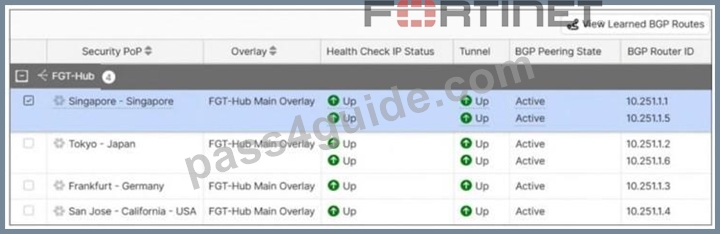
Which configuration setting should the administrator verify and correct first?
- A. Authentication Method
- B. Remote Gateway
- C. BGP Peer IP
- D. Network overlay ID
Answer: C
Explanation:
For an SPA service connection, BGP Peering is critical for route exchange between the FortiSASE POP and the FortiGate hub. If connectivity issues occur, the administrator should first verify the BGP Peer IP and ensure correct configuration, as incorrect BGP settings can prevent proper routing of SPA traffic.
NEW QUESTION # 61
Which two deployment methods are used to connect a FortiExtender as a FortiSASE LAN extension?
(Choose two.)
- A. Configure an IPsec tunnel on FortiSASE to connect to FortiExtender.
- B. Enable Control and Provisioning Wireless Access Points (CAPWAP) access on the FortiSASE portal.
- C. Connect FortiExtender to FortiSASE using FortiZTP
- D. Enter the FortiSASE domain name in the FortiExtender GUI as a static discovery server
Answer: C,D
Explanation:
There are two deployment methods used to connect a FortiExtender as a FortiSASE LAN extension:
* Connect FortiExtender to FortiSASE using FortiZTP:
* FortiZero Touch Provisioning (FortiZTP) simplifies the deployment process by allowing FortiExtender to automatically connect and configure itself with FortiSASE.
* This method requires minimal manual configuration, making it efficient for large-scale deployments.
* Enter the FortiSASE domain name in the FortiExtender GUI as a static discovery server:
* Manually configuring the FortiSASE domain name in the FortiExtender GUI allows the extender to discover and connect to the FortiSASE infrastructure.
* This static discovery method ensures that FortiExtender can establish a connection with FortiSASE using the provided domain name.
References:
FortiOS 7.6 Administration Guide: Details on FortiExtender deployment methods and configurations.
FortiSASE 23.2 Documentation: Explains how to connect and configure FortiExtender with FortiSASE using FortiZTP and static discovery.
NEW QUESTION # 62
Refer to the exhibit.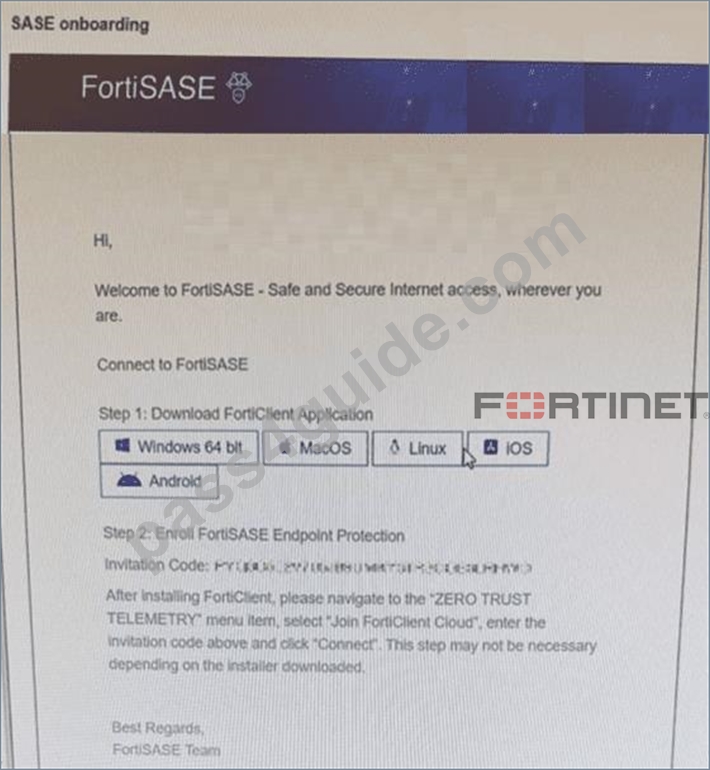
Which two statements about the onboarding process shown in the exhibit are true? (Choose two answers)
- A. This is an email from the FortiSASE platform to an end user.
- B. Depending on the installer used, the invitation code step may be skipped.
- C. The invitation code must always be entered manually after installing FortiClient.
- D. The user must manually select which FortiSASE components to install during the FortiClient setup.
Answer: A,B
Explanation:
The exhibit (image_6361c9.jpg) displays a standard SASE onboarding email sent from the FortiSASE platform to an end user to facilitate the enrollment of their device.
* Communication Source (D): This email is generated by the FortiSASE administrator through the Onboard Users menu in the FortiSASE portal. It provides the user with direct download links for the FortiClient application and a unique Invitation Code required for telemetry connection.
* Installer Types and Automation (B): FortiSASE provides two primary methods for deploying the client agent:
* Pre-configured Installer: This version is pre-packaged with the organization's unique invitation code built-in. When a user runs this installer, the invitation code step is skipped as the client automatically registers to the correct FortiSASE instance upon installation.
* Manual Installer: This version requires the user to manually copy and paste the invitation code from the onboarding email into the FortiClient "Zero Trust Telemetry" menu to complete enrollment.
* Analysis of Incorrect Options:
* Option A: FortiSASE utilizes a unified agent (FortiClient). The components (VPN, ZTNA, Web Filter, etc.) are managed via Endpoint Profiles assigned in the SASE portal and pushed to the client automatically; they are not manually selected by the user during installation.
* Option C: As noted above, if the administrator provides a pre-configured installer, the manual entry of the code is not required, making the statement that it must "always" be entered manually false.
NEW QUESTION # 63
Refer to the exhibit. A customer needs to implement device posture checks for their remote endpoints while accessing the protected server. They also want the TCP traffic between the remote endpoints and the protected servers to be processed by FortiGate.
In this scenario, which two setups will achieve these requirements? (Choose two.)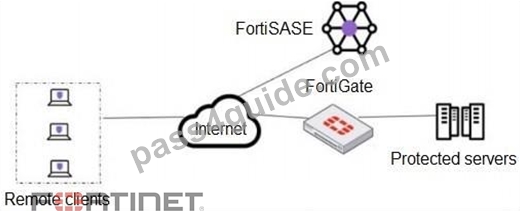
- A. Configure ZTNA tags on FortiGate.
- B. Configure private access policies on FortiSASE with ZTNA.
- C. Configure FortiGate as a zero trust network access (ZTNA) access proxy.
- D. Configure ZTNA servers and ZTNA policies on FortiGate.
Answer: C,D
Explanation:
To enforce device posture checks and ensure that TCP traffic flows through FortiGate, the FortiGate must act as a ZTNA access proxy and host the ZTNA servers and policies. This setup allows posture validation via FortiSASE while routing traffic securely to protected servers through FortiGate.
NEW QUESTION # 64
Refer to the exhibit.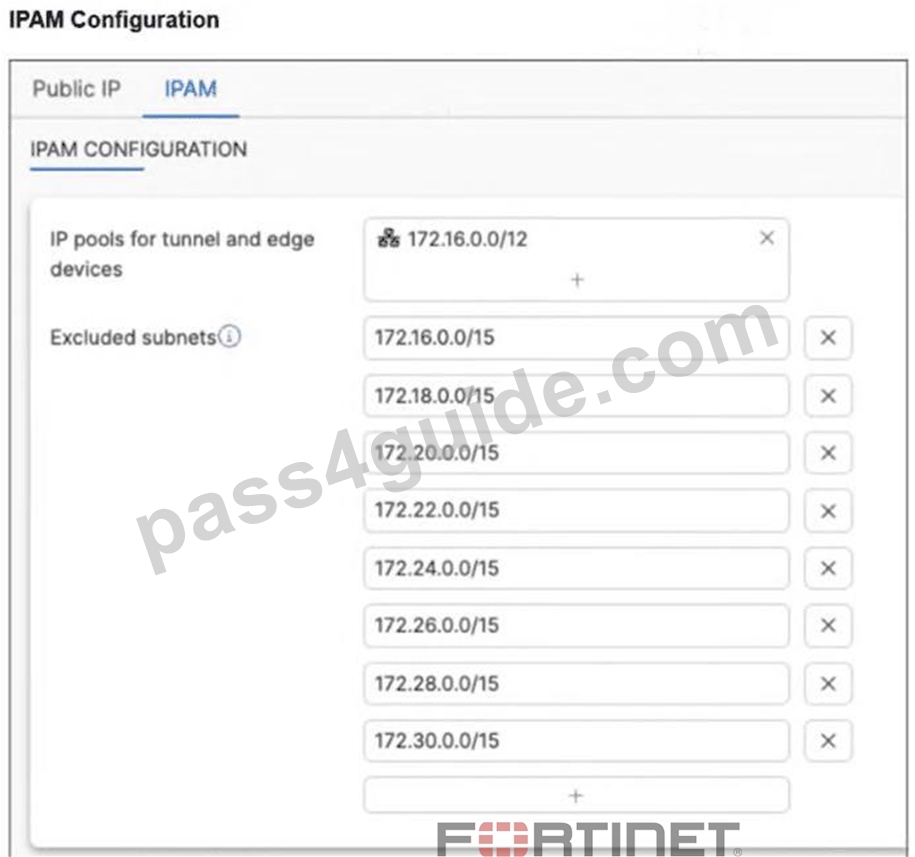
A customer wants to fine-tune network assignments on FortiSASE, so they modified the IPAM configuration as shown in the exhibit. After this configuration, the customer started having connectivity problems and noticed that devices are using excluded ranges. What could be causing the unexpected behavior and connectivity problems? (Choose two answers)
- A. The customer excluded too many networks from the pool.
- B. The pool must include at least one /20 per Instance for the IPAM to work correctly.
- C. The pool must include at least one /16 per Instance for the IPAM to work correctly.
- D. The pool must include at least one /20 per security POP for the IPAM to work correctly.
Answer: A,D
Explanation:
IP Address Management (IPAM) in FortiSASE is responsible for automatically allocating subnets to various services, including VPN tunnels and Edge devices. When an administrator modifies the default IPAM configuration, they must adhere to specific architectural scaling requirements.
* Subnet Requirements per PoP: FortiSASE architecture requires a minimum amount of address space to be available for each provisioned Security Point of Presence (PoP) to handle internal routing and endpoint assignments. For the IPAM engine to function correctly and distribute unique subnets across the global infrastructure, the pool must provide at least one /20 subnet per security PoP. If the available space is smaller than this per-PoP requirement, the allocation logic may fail or produce unpredictable routing behavior.
* Impact of Excessive Exclusions: In the exhibit (image_578940.png), the customer has defined a large summary pool of 172.16.0.0/12. However, they have configured eight separate /15 excluded subnets:
172.16.0.0/15, 172.18.0.0/15, 172.20.0.0/15, 172.22.0.0/15, 172.24.0.0/15, 172.26.0.0/15, 172.28.0.0
/15, and 172.30.0.0/15.
* Calculating the Exhaustion: A /12 network contains exactly eight /15 blocks. By excluding all eight
/15 ranges listed in the exhibit, the customer has effectively excluded 100% of the available addresses from the primary 172.16.0.0/12 pool.
* Connectivity Problems: When the IPAM pool is exhausted or overly restricted, FortiSASE cannot assign valid, non-overlapping subnets to the PoPs. This leads to connectivity problems for remote users and can cause the system to "fall back" to ranges it believes are available, even if they were intended to be excluded, or simply fail to establish tunnels entirely.
To resolve this, the administrator must ensure that the excluded subnets do not consume the entire pool and that the remaining unexcluded space is large enough to provide a /20 block for every active PoP in their subscription.
NEW QUESTION # 65
An administrator must restrict endpoints from certain countries from connecting to FortiSASE. Which configuration can achieve this? (Choose one answer)
- A. A geography address object as the source for a deny policy
- B. A network lockdown policy on the endpoint profiles
- C. Geofencing to restrict access from the required countries
- D. Source IP anchoring to restrict access from the specified countries
Answer: C
Explanation:
To restrict endpoints from certain countries from connecting to FortiSASE, the administrator should configure Geofencing. This feature provides granular control over which geographic locations are permitted or denied access to the SASE infrastructure.
Geofencing in FortiSASE
Geofencing is the primary mechanism for controlling remote user connectivity based on their origin.
* Functionality: It uses a geography-to-IP mapping database to identify the location of incoming connection requests.
* Access Modes: Administrators can choose between two main modes:
* Allow: Only users from specified countries can connect; all others are blocked.
* Deny: Users from specified countries are blocked; all others are allowed.
* Configuration Path: In the FortiSASE GUI, navigate to Configuration > Geofencing to enable the feature and add the relevant countries.
* Enforcement: Once enabled, the system automatically creates "local-in" policies to drop or permit traffic at the edge of the SASE PoPs before it can consume resources or attempt authentication.
NEW QUESTION # 66
Refer to the exhibit.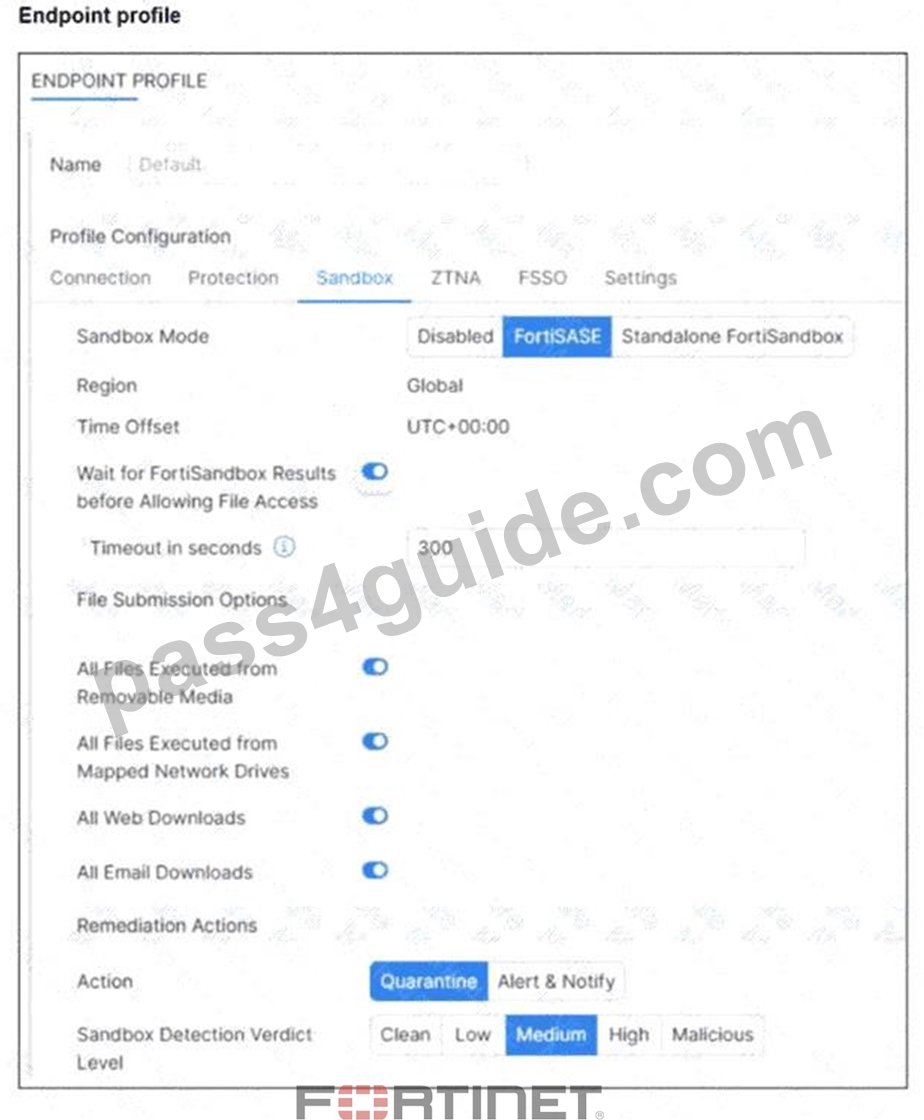
Based on the configuration shown, in which two ways will FortiSASE process sessions that require FortiSandbox inspection? (Choose two answers)
- A. All files will be sent to an on-premises FortiSandbox for inspection.
- B. Only endpoints assigned a profile for sandbox detection will be processed by the sandbox feature.
- C. All files executed on a USB drive will be sent to FortiSandbox for analysis.
- D. FortiClient quarantines only infected files that FortiSandbox detects as medium level.
Answer: B,C
Explanation:
The exhibit ( image_595357.jpg ) illustrates the Sandbox configuration tab within a FortiSASE Endpoint Profile . This profile dictates how the managed FortiClient agent handles suspicious files and interacts with the sandbox service.
* Profile-Based Enforcement: In the FortiSASE architecture, security features are not applied globally by default; they are enabled through specific profiles assigned to endpoints. Therefore, the sandbox inspection and remediation logic will only be active for endpoints that have been assigned a profile where the Sandbox feature is enabled.
* Removable Media Protection: Under the File Submission Options in the exhibit, the setting All Files Executed from Removable Media is toggled on. This ensures that any file executed from a USB drive or other external storage is sent to the FortiSandbox for analysis before being permitted to run on the endpoint.
* Sandbox Mode: The Sandbox Mode is set to FortiSASE , indicating that files are sent to the integrated cloud-native sandbox rather than an on-premises appliance. This makes Option A incorrect.
* Quarantine Threshold: The Remediation Actions show that the Action is set to Quarantine for files meeting the Sandbox Detection Verdict Level of Medium . This acts as a minimum threshold; FortiClient will quarantine files identified as Medium, High, or Malicious. Option B is incorrect because it implies only medium-level files are quarantined, whereas higher-risk levels would also be blocked.
NEW QUESTION # 67
How does FortiSASE Secure Private Access (SPA) facilitate connectivity to private resources in a hub-and- spoke network? (Choose one answer)
- A. SPA applies source network address translation (SNAT) for remote user traffic and uses IKEv1 for IPsec tunnels to connect to standalone hubs without BGP support.
- B. SPA connects a FortiSASE POP to a FortiGate hub or SD-WAN deployment using IPsec and BGP for dynamic route exchange with an easy configuration key for simplified setup on FortiOS.1
- C. SPA establishes direct links to spokes without IPsec or BGP and uses an easy configuration key to secure web traffic for remote users.
- D. SPA connects to private resources using HTTP and HTTPS protocols and relies on FortiClient for agentless access to SD-WAN deployments.
Answer: B
Explanation:
FortiSASE Secure Private Access (SPA) is designed to provide remote users with seamless and secure access to private applications hosted behind an organization's FortiGate Next-Generation Firewall (NGFW) or SD- WAN hubs.2
* Hub-and-Spoke Architecture: In this deployment model, the organization's FortiGate (either a standalone NGFW or an SD-WAN hub) acts as the hub, while the global FortiSASE Security Points of Presence (PoPs) act as spokes.3
* IPsec and BGP Integration: The connectivity between the FortiSASE PoPs and the corporate hub is established via IPsec VPN tunnels. To manage routing and ensure that remote users can reach the correct internal subnets, Border Gateway Protocol (BGP) is used for dynamic route exchange.4 This allows the hub to advertise internal prefixes to FortiSASE, enabling the PoPs to route user traffic effectively without requiring complex static route management.
* Simplified Configuration: To reduce administrative overhead and prevent manual configuration errors on the FortiOS side, Fortinet introduced the SPA easy configuration key (also known as an invitation code or simplified SPA setup). An administrator generates this key in the FortiSASE portal and enters it on the FortiGate hub. This triggers the Fabric Overlay Orchestrator to automatically provision the necessary IPsec tunnels, BGP peerings, and firewall policies required for SPA connectivity.
According to the FortiSASE 25 Architecture Guide, this method is preferred over legacy VPNs because it supports both TCP and UDP traffic, integrates natively with existing SD-WAN deployments, and automatically finds the shortest path to applications using ADVPN (Auto-Discovery VPN) shortcuts where applicable.
NEW QUESTION # 68
Which three traffic flows are supported by FortiSASE Secure Private Access (SPA)? (Choose three answers)
- A. From private resources to the internet.
- B. From private resources to FortiSASE agent-based users.
- C. From thin branches/branch on-ramp to private resources behind the Fortinet SD-WAN.
- D. From private resources to other private resources (SPA to SPA).
- E. From agent-based users to private resources behind the Fortinet SD-WAN.
Answer: B,C,E
Explanation:
FortiSASE Secure Private Access (SPA) provides flexible connectivity to internal corporate resources using a hub-and-spoke architecture where FortiSASE PoPs act as spokes to an organization ' s FortiGate hub.
* Flow from Agent-based users to Private Resources (C): This is the core functionality of SPA.
Remote users running FortiClient (agent-based) connect to the nearest FortiSASE PoP. The PoP, integrated into the corporate SD-WAN fabric, uses IPsec and BGP to route traffic to the private applications located behind the FortiGate hub or associated spokes.
* Flow from Thin Branches/Branch On-ramp to Private Resources (E): FortiSASE extends its security and connectivity to physical locations through " Thin Edge " (e.g., FortiExtender, FortiAP) or " Branch On-ramp " (e.g., branch FortiGates). These sites form tunnels to the FortiSASE PoP, which then provides them with access to the same private resources in the SD-WAN network as the remote agent- based users.
* Flow from Private Resources to Agent-based users (A): The SPA architecture is designed for bidirectional communication. Documentation confirms that traffic can be initiated from the FortiGate hub (or local networks behind it) to the remote VPN agents. This " Server-to-Client " flow is essential for administrative tasks, log forwarding, or real-time communication applications like VoIP.
Incorrect Options:
* Option B: Traffic from private resources to the internet is handled via Secure Internet Access (SIA) or local gateway policies, not the SPA use case, which is dedicated to internal private application access.
* Option D: While FortiSASE can facilitate branch-to-branch communication via ADVPN shortcuts, the term " SPA " specifically refers to the access layer for users and is not used to describe resource-to- resource or hub-to-hub traffic.
NEW QUESTION # 69
An organization must block user attempts to log in to non-company resources while using Microsoft Office 365 to prevent users from accessing unapproved cloud resources.
Which FortiSASE feature can you implement to meet this requirement?
- A. DNS filter with domain filter
- B. data loss prevention (DLP) with Microsoft Purview Information Protection (MPIP)
- C. application control with inline-CASB
- D. web filter with inline-CASB
Answer: C
Explanation:
Application control with inline-CASB allows FortiSASE to inspect and control application behavior at a granular level. This enables the organization to block login attempts to personal or non- corporate Microsoft Office 365 accounts, ensuring that only approved cloud resources are accessed.
NEW QUESTION # 70
Which two benefits come from integrating SoCaaS with FortiSASE? (Choose two answers)
- A. Eliminates the need of endpoint projection software
- B. Provides bandwidth usage analytics
- C. Continuous threat monitoring of all connected endpoints
- D. Centralized visibility of all threat events
Answer: C,D
NEW QUESTION # 71
What are the key differences between the FortiSASE BGP per overlay and BGP on loopback routing design methods? (Choose one answer)
- A. BGP per overlay is used for loopback interfaces to reduce routes, while BGP on loopback is the default method requiring separate iBGP sessions for each spoke.
- B. BGP per overlay simplifies hub configuration without mode-cfg, while BGP on loopback establishes multiple iBGP sessions for each tunnel to increase advertised routes.
- C. BGP per overlay can use separate iBGP sessions for each spoke-to-hub tunnel with mode-cfg enabled for IP address assignment, while BGP on loopback uses a single iBGP session per hub terminating on a loopback interface to simplify configuration and reduce advertised routes.
- D. BGP per overlay establishes a single iBGP session per hub on a loopback interface, while BGP on loopback requires mode-cfg for IP address assignment and uses multiple iBGP sessions per tunnel.
Answer: C
Explanation:
FortiSASE supports two main routing design methods for Secure Private Access (SPA) when connecting to a FortiGate SD-WAN hub:
* BGP per Overlay (Traditional/Default Method): In this configuration, a separate iBGP session is established over every individual IPsec overlay (tunnel) between the FortiSASE PoP and the hub. These sessions terminate on the tunnel interface IP addresses. To facilitate this, the hubs typically use the IPsec VPN mode-cfg feature to dynamically assign tunnel IP addresses to the SASE PoPs. For every LAN prefix, the system generates multiple BGP routes-one for each overlay-which increases the total number of routes advertised across the network.
* BGP on Loopback (Modern Alternative): This newer design establishes only a single iBGP session between the spoke and the hub, regardless of how many physical or logical overlays (tunnels) connect them. The session is terminated on a loopback interface on both sides.
* Key Advantages of BGP on Loopback:
* Reduced Complexity: It significantly simplifies the BGP configuration because there are fewer neighbors to manage.2
* Improved Scalability: It greatly reduces the volume of routes advertised, as only a single BGP route is generated for each LAN prefix, making it the preferred choice for large-scale deployments.
* Resiliency: The BGP session remains active as long as the loopback is reachable via any of the available overlays, meaning no BGP convergence is required if a single overlay fails.
NEW QUESTION # 72
An existing Fortinet SD-WAN customer is reviewing the FortiSASE ordering guide to identify which add-on is needed to allow future FortiSASE remote users to reach private resources.
Which add-on should the customer consider to allow private access?
- A. FortiSASE Branch On-Ramp add-on
- B. FortiSASE SPA add-on
- C. FortiSASE Dedicated Public IP Address add-on
- D. FortiSASE Global add-on
Answer: B
Explanation:
The Secure Private Access add-on enables FortiSASE remote users to reach private resources by providing private application access capabilities through SPA-based connectivity and secure tunneling into internal environments.
NEW QUESTION # 73
Which policy type is used to control traffic between the FortiClient endpoint to FortiSASE for secure internet access?
- A. secure web gateway (SWG) policy
- B. private access policy
- C. thin edge policy
- D. VPN policy
Answer: A
Explanation:
The Secure Web Gateway (SWG) policy is used to control traffic between the FortiClient endpoint and FortiSASE for secure internet access. SWG provides comprehensive web security by enforcing policies that manage and monitor user access to the internet.
* Secure Web Gateway (SWG) Policy:
* SWG policies are designed to protect users from web-based threats and enforce acceptable use policies.
* These policies control and monitor user traffic to and from the internet, ensuring that security protocols are followed.
* Traffic Control:
* The SWG policy intercepts all web traffic, inspects it, and applies security rules before allowing or blocking access.
* This policy type is crucial for providing secure internet access to users connecting through FortiSASE.
References:
FortiOS 7.6 Administration Guide: Details on configuring and managing SWG policies.
FortiSASE 23.2 Documentation: Explains the role of SWG in securing internet access for endpoints.
NEW QUESTION # 74
What is the purpose of security posture tagging in ZTNA?
- A. To categorize devices and users based on their role in the organization
- B. To provide granular access control based on the compliance status of devices and users
- C. To assign usernames to different devices for security logs
- D. To ensure that all devices and users are monitored continuously
Answer: B
Explanation:
Security posture tagging in ZTNA is used to evaluate and classify endpoints based on their compliance and security status, enabling granular, dynamic access control decisions that determine whether a device is allowed to access specific resources.
NEW QUESTION # 75
Which description of the FortiSASE inline-CASB component is true?
- A. It detects data in motion.
- B. It relies on API to integrate with cloud services.
- C. It has limited visibility when data is transmitted.
- D. It is placed outside the traffic path.
Answer: A
Explanation:
FortiSASE inline-CASB operates in the traffic path to provide real-time visibility and control over data in motion as it is transmitted to and from cloud applications.
NEW QUESTION # 76
How do security profile group objects behave when central management is enabled on FortiSASE?
- A. Objects that are only flow-based are supported.
- B. Objects are considered read-only on FortiSASE.
- C. Objects support two-way synchronization.
- D. Objects created on FortiSASE can be retrieved on FortiManager.
Answer: B
Explanation:
When central management is enabled, security profile group objects are managed exclusively through FortiManager, making them read-only on the FortiSASE portal to ensure centralized policy control.
NEW QUESTION # 77
Which two settings are automatically pushed from FortiSASE to FortiClient in a new FortiSASE deployment with default settings? (Choose two.)
- A. FortiSASE certificate authority (CA) certificate
- B. tunnel profile
- C. zero trust network access (ZTNA) tags
- D. real-time protection
Answer: A,B
Explanation:
In a new FortiSASE deployment with default settings, FortiClient automatically receives the FortiSASE CA certificate for SSL inspection and a tunnel profile to establish the secure connection to FortiSASE. Real-time protection and ZTNA tags must be configured separately.
NEW QUESTION # 78
Which three traffic flows are supported by FortiSASE Secure Private Access (SPA)? (Choose three answers)
- A. From private resources to the internet.
- B. From private resources to FortiSASE agent-based users.
- C. From thin branches/branch on-ramp to private resources behind the Fortinet SD-WAN.
- D. From private resources to other private resources (SPA to SPA).
- E. From agent-based users to private resources behind the Fortinet SD-WAN.
Answer: B,C,E
Explanation:
FortiSASE Secure Private Access (SPA) provides flexible connectivity to internal corporate resources using a hub-and-spoke architecture where FortiSASE PoPs act as spokes to an organization's FortiGate hub.
* Flow from Agent-based users to Private Resources (C): This is the core functionality of SPA.
Remote users running FortiClient (agent-based) connect to the nearest FortiSASE PoP. The PoP, integrated into the corporate SD-WAN fabric, uses IPsec and BGP to route traffic to the private applications located behind the FortiGate hub or associated spokes.
* Flow from Thin Branches/Branch On-ramp to Private Resources (E): FortiSASE extends its security and connectivity to physical locations through "Thin Edge" (e.g., FortiExtender, FortiAP) or
"Branch On-ramp" (e.g., branch FortiGates). These sites form tunnels to the FortiSASE PoP, which then provides them with access to the same private resources in the SD-WAN network as the remote agent-based users.
* Flow from Private Resources to Agent-based users (A): The SPA architecture is designed for bidirectional communication. Documentation confirms that traffic can be initiated from the FortiGate hub (or local networks behind it) to the remote VPN agents. This "Server-to-Client" flow is essential for administrative tasks, log forwarding, or real-time communication applications like VoIP.
Incorrect Options:
* Option B: Traffic from private resources to the internet is handled via Secure Internet Access (SIA) or local gateway policies, not the SPA use case, which is dedicated to internal private application access.
* Option D: While FortiSASE can facilitate branch-to-branch communication via ADVPN shortcuts, the term "SPA" specifically refers to the access layer for users and is not used to describe resource-to- resource or hub-to-hub traffic.
NEW QUESTION # 79
Which two of the following can release the network lockdown on the endpoint applied by FortiSASE? (Choose two.)
- A. When the endpoint is determined as compliant using ZTNA tags
- B. When the endpoint is determined as on-net
- C. When the endpoint connects to the FortiSASE tunnel
- D. When the endpoint is rebooted
Answer: A,B
Explanation:
FortiSASE releases network lockdown when the endpoint is evaluated as trusted within the security posture framework. This occurs when the device is identified as being on the trusted corporate network or when it meets compliance requirements validated through ZTNA posture and tagging, allowing normal network access to resume.
NEW QUESTION # 80
......
Prepare for the Actual Fortinet NSE 7 NSE7_SSE_AD-25 Exam Practice Materials Collection: https://prepcram.pass4guide.com/NSE7_SSE_AD-25-dumps-questions.html